
TL;DR
Is IGCSE accounting difficult? Not necessarily. Most students start around age 15, but some begin earlier. With the right understanding of concepts and consistent practice, many students find IGCSE Accounting manageable and even enjoyable.
Key Takeaways
- IGCSE Accounting is generally taken by students around Year 10 (about age 15).
- Some motivated students start learning accounting as early as age 12 as private candidates.
- The subject is not purely mathematics; it focuses mainly on logic, structure, and financial concepts.
- Students who practise regularly with past-year exam questions tend to improve quickly.
- Many students find accounting easier once they understand double-entry principles.
- Consistent practice over 12 to 24 months can significantly improve performance.
- With the right guidance, most students can score well in the subject.
Table of Contents
Introduction
Many parents and students often ask the same question when choosing subjects for the IGCSE programme: Is IGCSE accounting difficult?
The answer is not always straightforward. The difficulty of any academic subject depends on several factors, including the student’s learning style, their interest in business-related topics, and the quality of teaching they receive. While some students find accounting challenging at first, many discover that the subject becomes much easier once they understand the basic principles.
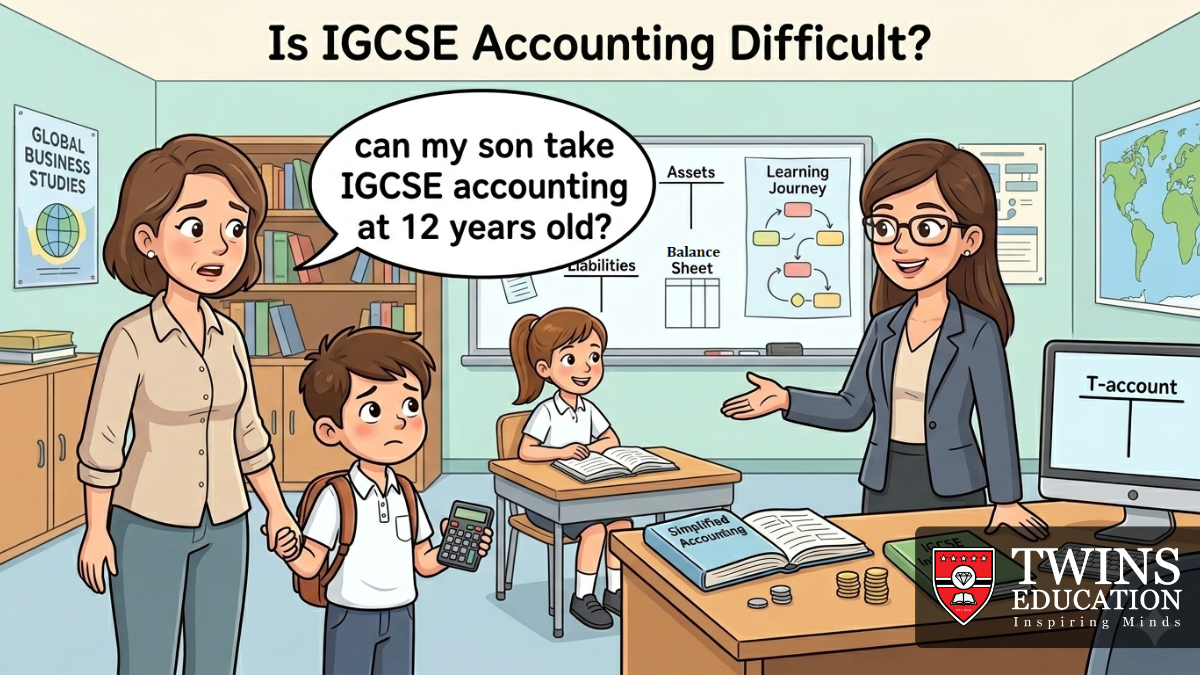
In most schools following the Cambridge IGCSE curriculum, students typically start studying accounting in Year 10, which is around age 15. However, there are also cases where younger students begin earlier. Some highly motivated learners even start learning IGCSE Accounting at age 12 as private candidates, although this is less common.
This article explains whether IGCSE accounting is difficult, what factors affect the learning process, and at what age students should ideally begin studying the subject.
What Makes IGCSE Accounting Difficult for Some Students?
When students first encounter accounting, they often assume it is a complicated subject because it involves numbers and financial statements. This leads many parents to ask: Is IGCSE accounting difficult for beginners?
In reality, accounting is not primarily about complex mathematics. Instead, it focuses on understanding financial transactions and recording them correctly.
Several factors can influence whether a student finds the subject challenging.
1. Understanding Double Entry Principles
One of the first concepts students learn is the double-entry system. This principle means that every financial transaction affects at least two accounts.
For example:
- Buying equipment increases assets
- Paying cash decreases assets
Many students initially struggle with this concept. However, once they understand the logic behind it, accounting becomes much more systematic and predictable.
2. Lack of Practice
Accounting is a skills-based subject, which means practice is essential. Students who regularly practise past-year questions often improve significantly within a few months.
Cambridge IGCSE examinations usually require students to apply accounting principles in structured questions. According to exam feedback reports, students who practise at least 5 to 10 past papers before the exam often perform much better than those who rely only on textbook reading.
3. Weak Foundation in Financial Concepts
Students who have never been exposed to business concepts may take longer to understand topics such as:
- Profit and loss
- Assets and liabilities
- Cash flow
- Business transactions
Once these concepts become familiar, the learning curve becomes much smoother.
Is IGCSE Accounting Hard Compared to Other IGCSE Subjects?
Another common question is whether accounting is harder than other subjects like mathematics, economics, or business studies.
When comparing subjects, the perceived difficulty often depends on the student’s strengths.
For example:
- Students who enjoy logical thinking and structured answers often find accounting easier.
- Students who prefer essay writing may find subjects like economics or business studies more comfortable.
One advantage of accounting is that it is a highly structured subject. Many exam questions follow a predictable format. This means that students who practise regularly can become familiar with the exam style.
In addition, accounting exams often reward method and accuracy, rather than lengthy explanations. This can benefit students who prefer solving problems rather than writing essays, although it does require students to evaluate in some questions.
Because of this structure, some students actually find accounting more manageable than theory-heavy subjects.
What Age Should Students Start Learning IGCSE Accounting?
Parents frequently ask: Is IGCSE accounting difficult for younger students, and what age should they start learning it?
In most schools, students begin studying IGCSE Accounting in Year 10, which is typically around 15 years old. This allows them about two years of preparation before sitting the IGCSE examination in Year 11.
The two-year timeframe is generally considered ideal because it allows students to:
- Build strong conceptual understanding
- Practise exam questions gradually
- Develop confidence in preparing financial statements
A structured learning period of 18 to 24 months helps students absorb the material without feeling overwhelmed.
Can Students Start IGCSE Accounting at Age 12?
Although the usual starting age is around 15, some students begin learning earlier.
In rare cases, highly motivated students start studying accounting at age 12 or 13 as private candidates. This often happens when students:
- Have a strong interest in business or entrepreneurship
- Are academically advanced for their age
- Want to take additional subjects earlier
However, starting early does not necessarily mean the subject becomes easier. Younger students may require more guidance and practice to fully understand the concepts.
From teaching IGCSE Accounting in tuition centres, most students tend to perform best when they begin learning accounting between ages 14 and 16. At this stage, they usually have stronger logical reasoning skills and greater academic maturity.
Who Is IGCSE Accounting Most Suitable For?
So, is IGCSE accounting difficult for everyone? The answer is no. In fact, the subject can be very suitable for certain types of students.
Students who usually perform well in accounting often have the following traits:
1. Logical Thinkers
Accounting involves analysing transactions and categorising them correctly. Students who enjoy solving structured problems often find this process satisfying.
2. Students Interested in Business
Learners who are curious about how businesses operate often find accounting meaningful. They can see how financial records help companies track profits and expenses.
3. Students Who Like Clear Answer Structures
Unlike some essay-based subjects, accounting answers usually follow a clear format. Once students understand the structure, they can apply it consistently across many questions.
Because of these characteristics, accounting can be a very rewarding subject for students who enjoy analytical thinking.
How to Make IGCSE Accounting Easier to Learn
Even if students initially wonder “Is IGCSE accounting difficult?”, there are several effective ways to make the subject easier.
1. Master the Basics Early
Topics such as:
- Double entry
- Trial balance
- Ledger accounts
form the foundation of accounting. Students who fully understand these concepts often find later chapters much easier.
2. Practise Past-Year Exam Papers
Past exam papers are one of the most effective preparation tools.
Many teachers recommend practising at least 5 years of past papers, which could amount to 20 to 30 full exam papers (including all variants). This helps students recognise common question patterns.
3. Learn Step-by-Step Problem Solving
Accounting questions usually follow a sequence of steps. When students break down each problem logically, the solution becomes clearer.
4. Review Mistakes Regularly
One of the fastest ways to improve is to review incorrect answers. Identifying why a mistake occurred helps students avoid repeating it.
5. Seek Guidance from Experienced Teachers
Guidance from teachers who are familiar with the IGCSE syllabus can make a significant difference. Experienced tutors often know which topics students struggle with the most and can provide targeted support.
With the right learning strategy, many students discover that accounting is much more manageable than they initially expected.
Conclusion
So, is IGCSE accounting difficult? The honest answer is that it depends on the student’s approach, preparation, and interest in the subject.
For most students, IGCSE Accounting becomes manageable once they understand the core principles, especially the double entry system and financial statement preparation. Regular practice with exam-style questions also plays a crucial role in building confidence and accuracy.
Typically, students begin studying the subject around age 15 in Year 10, which provides about two years of preparation before the final examination. While some students start earlier as private candidates, the ideal starting age often falls between 14 and 16 years old, when students have developed stronger analytical thinking skills.
Ultimately, IGCSE Accounting is not necessarily a difficult subject. With consistent practice, structured learning, and proper guidance, many students find that accounting becomes a logical and rewarding subject that can open doors to future studies in ACCA, finance, business, and economics.


