
TL;DR
IGCSE Business evaluation marks are often the difference between an A and a C. In this guide, we explain what examiners look for, how to structure evaluation answers, common mistakes students make, and 10 realistic examples with sample evaluation responses for both Paper 1 and Paper 2.
Key Takeaways
- Evaluation is one of the most difficult skills in IGCSE Business Studies.
- Many students confuse analysis with evaluation.
- Strong evaluation answers require judgement, justification, and contextual reasoning.
- Examiners reward balanced arguments and supported conclusions.
- Paper 1 and Paper 2 require slightly different evaluation approaches.
- Weak conclusions often cause students to lose valuable marks.
- Using contextual business information improves evaluation quality significantly.
- Students should avoid generic phrases without explanation.
- Practising realistic evaluation questions can improve marks quickly.
- Consistent exposure to examiner-style answering techniques helps students score better over time.
Table of Contents
Introduction
Many students in Accounting, Business and Economics lose IGCSE Business evaluation marks not because they lack business knowledge, but because they do not fully understand what examiners actually want in higher-mark answers.
In IGCSE Business Studies, especially in Paper 1 and Paper 2, evaluation is considered one of the hardest assessment skills. Students may know the definitions, calculations, and business concepts well, yet still struggle to move beyond basic analysis into proper evaluation.
At TWINS Education, our IGCSE Business tutors often notice that students can explain advantages and disadvantages clearly, but fail to provide a convincing judgement. This becomes especially obvious in 6-mark and 12-mark questions where evaluation marks play a major role in separating average answers from excellent ones.
In many cases, evaluation can determine whether a student achieves an A*, A, or B.
This article explains:
- what IGCSE Business evaluation marks actually mean,
- what examiners look for,
- the difference between analysis and evaluation,
- how students can move beyond band 3 sample answers for IGCSE Business,
- common mistakes students make,
- and 10 realistic evaluation questions with sample answers.
If you have ever wondered why your answers “sound correct” but still do not score highly, this guide will help you understand how evaluation really works in IGCSE Business Studies.
What Are Evaluation Marks in IGCSE Business Studies?
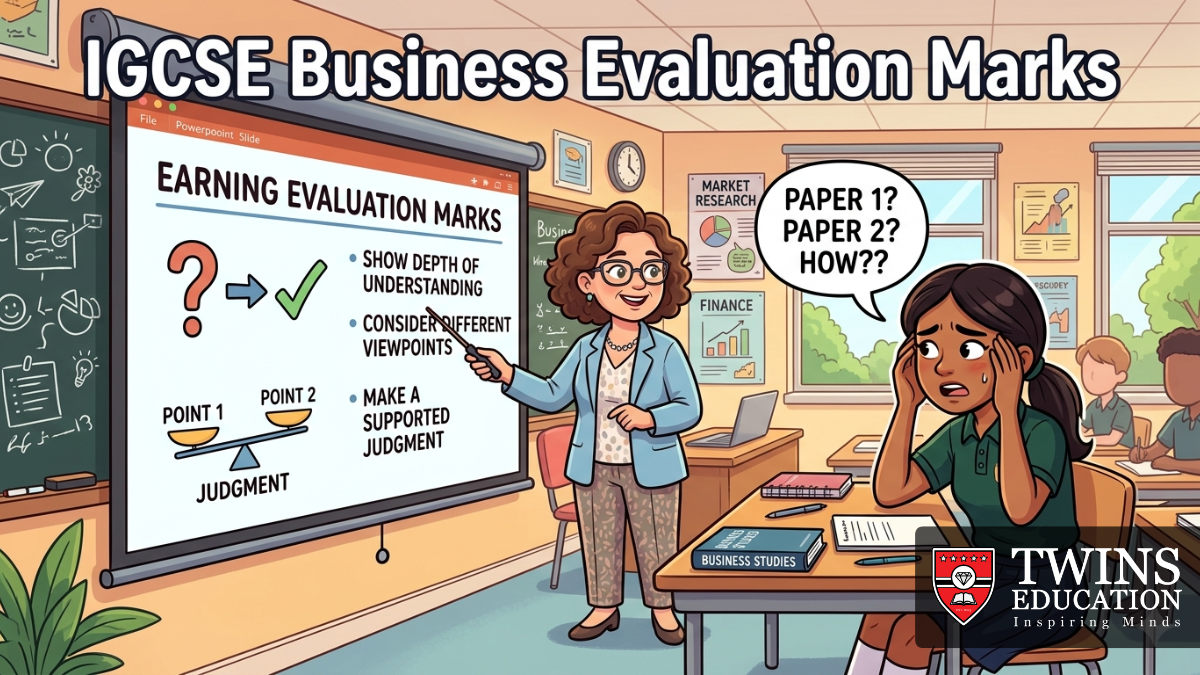
IGCSE Business evaluation marks are awarded when students make a supported judgement after considering different business factors.
This means students must:
- weigh both sides of an argument,
- consider business context,
- prioritise important factors,
- and justify why one option is better than another.
Evaluation is not simply listing pros and cons.
For example:
Weak answer:
“Advertising is expensive but it can increase sales.”
This is analysis, not evaluation.
Stronger evaluation:
“Although advertising is expensive, it may be worthwhile for a new business because increasing brand awareness quickly could help the business gain market share before competitors enter the market.”
The second answer includes:
- judgement,
- prioritisation,
- context,
- and business reasoning.
These are exactly the skills examiners reward when awarding IGCSE Business evaluation marks.
Why Evaluation Is the Hardest Skill in IGCSE Business
According to many examiner reports, students commonly struggle with evaluation because they rely too heavily on memorised answers.
Business Studies is not only about recalling knowledge. It is about applying business logic to specific situations.
Evaluation becomes difficult because students must:
- think critically,
- compare alternatives,
- explain consequences,
- and justify decisions.
In Paper 2 especially, students are expected to evaluate using information from the case study.
At TWINS Education, many students initially write generic conclusions such as:
- “Therefore this is a good idea.”
- “This will help the business.”
- “This is the best option.”
However, these statements alone rarely earn strong IGCSE Business evaluation marks because they lack justification.
Strong evaluation requires evidence and explanation.
What Examiners Actually Look for in Evaluation Answers
Examiners generally reward answers that contain:
1. A Clear Judgement
Students should clearly choose a side or make a decision.
2. Context
Answers should refer to the business scenario.
For example:
- size of business,
- type of industry,
- financial situation,
- target market,
- competition,
- or economic conditions.
3. Justification
Students must explain WHY their chosen option is better.
4. Prioritisation
Better answers identify the most important factor rather than treating all points equally.
5. Long-Term Thinking
High-level evaluation often considers future impact rather than immediate effects only.
For instance:
“Although reducing prices may increase short-term sales, the business could damage its brand image in the long run if customers begin associating the company with lower quality products.”
This type of thinking often earns higher IGCSE Business evaluation marks.
The Difference Between Analysis and Evaluation in IGCSE Business
Many students confuse analysis and evaluation.
| Skill | Meaning |
| Knowledge | Stating points, facts or definitions |
| Application | Using case study information |
| Analysis | Explaining causes or effects |
| Evaluation | Making supported judgements |
Example question:
Should a business introduce online selling?
Analysis:
“Online selling can increase sales because customers can purchase products more conveniently.”
Evaluation:
“Although online selling may increase sales, the business must consider whether it has sufficient capital to develop an effective website. For a small business with limited finance, the high setup cost may outweigh the potential benefits initially.”
This is similar to what students struggle with when comparing IGCSE Economics knowledge is important but not enough to produce strong business evaluation answers.
The second answer demonstrates stronger IGCSE Business evaluation marks potential because it weighs factors and considers context.
How to Write High-Scoring Evaluation Answers for Paper 1 and Paper 2
Paper 1
Paper 1 evaluation answers are usually shorter.
Students should:
- answer directly,
- include one judgement,
- justify clearly,
- and use brief context.
A good structure:
- State decision
- Explain reason
- Link to business impact
Paper 2
Paper 2 requires deeper evaluation because of the case study format.
Students should:
- use case study evidence,
- compare alternatives,
- prioritise factors,
- and provide developed conclusions.
At TWINS Education, our tutors often encourage students to spend at least 20% to 25% of their answer focusing on evaluation in longer questions.
This small adjustment alone can improve IGCSE Business evaluation marks significantly.
Common Mistakes That Cause Students to Lose Evaluation Marks
1. Generic Conclusions
Students often write conclusions that could apply to any business.
2. No Justification
A judgment without explanation is weak.
3. Repeating Earlier Points
Evaluation should develop ideas, not repeat analysis.
4. Ignoring Context
Examiners want answers linked to the specific business.
5. One-Sided Answers
Balanced discussion is usually stronger.
Avoiding these mistakes (as seen in common errors in IGCSE Business) can improve IGCSE Business evaluation marks quickly.
10 IGCSE Business Evaluation Questions with Sample Answers
1. Should a business lower prices during a recession?
Lowering prices may help increase sales during a recession because customers become more price-sensitive. However, if profit margins are already low, reducing prices further could harm long-term profitability.
2. Is social media marketing effective for small businesses?
Social media marketing can be cost-effective for small businesses with limited budgets. However, success depends heavily on the business understanding its target audience and maintaining consistent online engagement.
3. Should a business expand internationally?
International expansion could increase revenue opportunities, but the business may face higher risks such as cultural differences and increased operating costs.
4. Is automation better than hiring more workers?
Automation may improve productivity and reduce labour costs over time. However, the high initial investment may not be suitable for smaller businesses with limited capital.
5. Should a business increase employee wages?
Higher wages could improve employee motivation and reduce labour turnover. However, the business must ensure that increased payroll costs do not reduce competitiveness.
6. Is market research necessary before launching a product?
Conducting market research reduces the risk of product failure because customer preferences can be identified early. This is especially important in highly competitive industries.
7. Should a business use bank loans for expansion?
Bank loans allow businesses to grow faster without giving up ownership. However, if sales do not increase as expected, repayment obligations could create financial pressure.
8. Is e-commerce suitable for all businesses?
E-commerce offers wider market reach and convenience, but some businesses may still depend heavily on physical customer interaction and personalised service.
9. Should businesses outsource production?
Outsourcing may reduce costs, but quality control could become more difficult if production takes place overseas.
10. Is customer service more important than price?
Good customer service may improve customer loyalty in the long term, while low prices may only attract short-term purchases. Therefore, service quality could be a more sustainable competitive advantage.
These examples demonstrate the level of judgement needed for stronger IGCSE Business evaluation marks.
Evaluation Sentence Starters and Conclusion Phrases for IGCSE Business
Students can improve answer quality using phrases such as:
- “This depends on…”
- “In the long term…”
- “The most important factor is…”
- “Although this may…, it could also…”
- “This is likely to be more effective because…”
- “For a small business…”
- “Given the business context…”
At TWINS Education, tutors often encourage students to prepare flexible evaluation phrases before examinations. This helps students write more confidently under time pressure.
Final Tips to Improve Your Evaluation Marks in IGCSE Business Studies
Improving IGCSE Business evaluation marks takes consistent practice.
Students should:
- review examiner reports,
- practice timed questions,
- compare strong and weak answers,
- and focus on judgement quality rather than memorisation alone.
Even practising one evaluation question daily for 30 days can create noticeable improvement.
Many strong students aiming for scoring A or A* in IGCSE Business are not necessarily the ones with the most business knowledge. Instead, they are often the students who can explain business decisions clearly and logically.
Conclusion
IGCSE Business evaluation marks are one of the most important factors in achieving high grades in both Paper 1 and Paper 2. While many students understand business concepts and maths calculations well, they often struggle to develop convincing judgments and contextual conclusions.
Strong evaluation answers require more than advantages and disadvantages. Examiners look for prioritisation, justification, business context, and long-term reasoning.
By understanding what examiners actually expect, avoiding common mistakes, and practising realistic evaluation questions regularly, students can improve their answering techniques significantly.
At TWINS Education, we consistently help students strengthen their evaluation skills through examiner-focused teaching methods, structured answering techniques, and realistic business case study practice, especially for those considering future studies in university in business, economics, or related fields.
With the right strategy and enough exposure to high-quality examples, earning stronger IGCSE Business evaluation marks becomes much more achievable.


