Looking for a smarter way to revise for your IGCSE Economics exam?
IGCSE Economics Notes Study Guide (Free Online Version)
Preparing for the IGCSE Economics exam can feel challenging with so many theories, graphs, and definitions to remember. That’s why TWINS Education has created this free set of IGCSE economics notes online. These notes are structured to make your revision simpler, clearer, and exam-focused.
Whether you’re studying independently or attending IGCSE Economics tuition (face-to-face or online), this study guide provides a solid foundation in economic principles, real-world applications, and exam strategies Cambridge examiners look for.
Explore the full interactive version of the guide below. You can read it directly online for easy access anytime. You can also browse our collection of free IGCSE study guides for other subjects.
NOTE: For the best experience, we recommend viewing it on a desktop, laptop, or tablet.

IGCSE teachers showing the Study Guide materials.

Students preparing for their IGCSE Examinations
About This IGCSE Economics Notes Study Guide
With over 691 positive reviews, this free study guide compiles essential IGCSE Economics notes to help students revise in a more systematic way. Instead of long textbook explanations, it focuses on simplified summaries, key terms, and exam-focused concepts.
What’s inside these IGCSE Economics notes:
- Topic-by-topic coverage that follows the official Cambridge IGCSE Economics (0455) syllabus.
- Core economic concepts explained in straightforward language.
- Graphs and diagrams simplified for easier understanding.
- Real-world examples showing how economic theory applies in practice.
- Structured layout for quick review and effective exam preparation.
Prepared by TWINS Education’s experienced tutors, these notes are best used alongside past papers, timed practices, and regular revision.
Related Searches for IGCSE Economics Notes
Students often look for IGCSE economics notes that simplify difficult concepts such as demand and supply, market structures, and government policies. Many prefer revision notes, summary notes, and free IGCSE economics notes that allow quick revision before exams. Others rely on Cambridge IGCSE economics notes, study guides, and downloadable IGCSE economics notes PDF for structured learning.
Exam-focused searches include economics past paper notes, exam tips, and model answers to understand how marks are awarded. Learners also find value in chapter notes, short notes, and condensed notes when revising under time pressure. For those aiming for top grades, quick revision materials, the best IGCSE economics notes, and sets of revision questions with answers are highly sought after. Access to reliable IGCSE economics revision resources helps students strengthen their knowledge and approach the exams with confidence.
Our IGCSE teachers at TWINS Education presenting the Study Guide materials.
Submit Your Details & We Will Get Back To You!
Common FAQs About IGCSE Economics
1. Is IGCSE Economics hard?
IGCSE Economics can be challenging because it mixes theory, diagrams, and real-world application. With consistent revision, practice on past papers, and the use of clear IGCSE Economics notes, students can perform very well.
2. How many papers are there in IGCSE Economics?
There are two papers:
- Paper 1: Multiple-choice (30%)
- Paper 2: Structured and data-response (70%)
Both test the application of economic theory.
3. What topics are covered in IGCSE Economics?
Key topics include:
- The basic economic problem and resource allocation
- Microeconomic decision makers
- Government and the macroeconomy
- International trade and globalisation
- Economic development
4. What’s the best way to study for IGCSE Economics?
The most effective method is to revise IGCSE Economics notes, practise past papers, and redraw key diagrams from memory. Applying economic theory to real-world examples strengthens answers and improves exam performance.
5. How many past papers should I practise for IGCSE Economics?
Students aiming for top grades usually complete at least 5 to 7 years of past papers. Pairing this with structured revision notes for IGCSE Economics helps identify recurring topics and sharpen exam technique.
6. What are the most common mistakes in IGCSE Economics?
Frequent errors include mislabelling diagrams, mixing up definitions, and writing generic answers without application. Reviewing concise IGCSE Economics notes and practising past questions reduces these mistakes.
7. How much time should I spend studying IGCSE Economics each week?
Most students benefit from 4 to 6 hours of revision weekly. Using concise IGCSE Economics notes helps make study time more efficient by focusing on high-priority exam topics.
8. Can I get an A in IGCSE Economics without tuition?
Yes, with strong discipline, consistent practice, and organised IGCSE Economics notes, it is possible. However, many students choose tuition to strengthen exam techniques and gain personalised guidance.
9. Are there free IGCSE Economics resources available?
Yes. Free past papers, examiner reports, and revision notes for IGCSE Economics are available online. TWINS Education also provides additional notes and practice materials to support learning.
10. Which is harder, IGCSE Economics or Business Studies?
Economics generally requires more theory, diagrams, and data-response analysis. Business Studies focuses more on case studies. Many students find Economics slightly harder, but structured IGCSE Economics notes make it manageable.
11. Is IGCSE Economics useful for future studies?
Yes. It builds a strong foundation for A-Level Economics, Business, and related fields. The subject also develops problem-solving, analytical, and decision-making skills that are highly valued in higher education.
12. How can TWINS Education help me in IGCSE Economics?
TWINS Education provides face-to-face and online tuition with structured IGCSE Economics notes, exam-style practice, and personalised feedback to help students excel in exams.
13. Where can I find reliable IGCSE Economics tuition in Malaysia?
TWINS Education is a trusted IGCSE tuition centre in Malaysia. We offer Economics, Business, Accounting, Maths, English, and more. Students can join our physical classes at various branches or online lessons internationally.
14. Where can I take the IGCSE Economics (0455) exam?
Students using our IGCSE Economics study notes can sit for the exam at approved Cambridge centres. You may check our Find a Cambridge exam venue near you page for registration details.
Related Study Guide Notes

- IGCSE Accounting Notes Study Guide
- IGCSE Business Notes Study Guide
- IGCSE Mathematics Notes Study Guide
- IGCSE Add Maths Notes Study Guide
- IGCSE Biology Notes Study Guide
- IGCSE Chemistry Notes Study Guide
- IGCSE Physics Notes Study Guide
- IGCSE Maths Notes Study Guide (Lower Secondary)
- IGCSE Science Notes Study Guide (Lower Secondary)
Other IGCSE Economics Resources

Is IGCSE Economics Hard? A Complete Guide for Students Choosing Their Electives
Is IGCSE Economics hard? It is one of the most common questions students and parents ask when choosing IGCSE electives. While the subject introduces new concepts and requires analytical thinking, it is not necessarily one of the hardest IGCSE subjects. In this guide, we explain what makes IGCSE Economics challenging, what makes it manageable, and how students can improve their chances of scoring excellent grades.

IGCSE Economics as an Extra Subject: A Complete Guide for Science Students
Many parents assume that choosing the Science Stream means their child cannot study Economics. Fortunately, that is not true. This guide explains everything you need to know about IGCSE Economics as an extra subject, including who should take it, how private candidate registration works, and whether science students can cope with the subject successfully.

A-Level Business vs Economics: Which Subject Should You Choose?
Choosing between A-Level Business vs Economics is a common dilemma for students after IGCSE or SPM. This guide breaks down the key differences, difficulty level, and future pathways to help you make the right decision.

How to Write A-Level Economics Essay (Structure, Sample & Scoring Guide)
Struggling with essays? Learn how to write a level economics essay with the right structure, real sample answers, and examiner insights to score top marks.

Does IGCSE Economics Help in College or University? A Complete Guide for Parents
Does IGCSE Economics help in college or university? Although it is rarely a compulsory requirement, studying IGCSE Economics gives students a valuable head start in business related courses, analytical thinking, and academic confidence. Learn how this subject can benefit your child beyond secondary school.

Is A-Level Economics Hard? An Honest Guide for IGCSE Students
Is A-Level Economics hard? Many IGCSE students underestimate the jump. Here’s an honest breakdown of the difficulty and how to succeed.

How to Score A in A-Level Economics (Proven Study & Exam Strategies)
Struggling with how to score A in A-Level Economics? This guide shares proven strategies, study techniques, and exam tips to help you achieve top grades.

IGCSE Business vs Economics vs Accounting: Which Subject Is Easier to Score A or A*?
Choosing between IGCSE business vs economics vs accounting is a common dilemma for Year 9 students entering Year 10. Many international schools offer limited elective options, leaving students wondering which subject is easier to score A or A*. This guide explains the key differences, difficulty levels, and how students should decide based on their strengths.
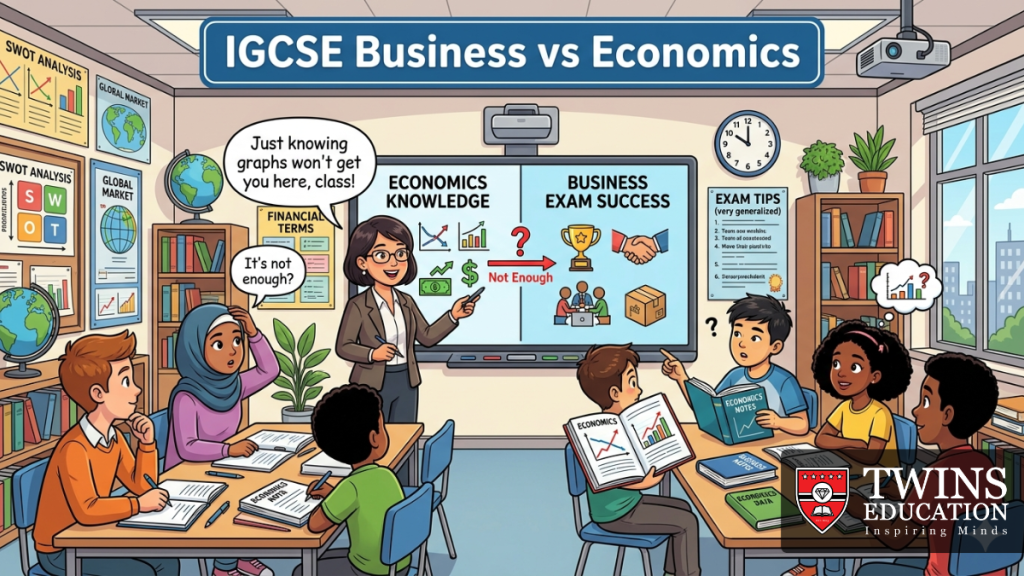
IGCSE Business vs Economics: Why Economics Knowledge Alone Is Not Enough for Business Exam Success
Many students believe that studying IGCSE Economics automatically prepares them for IGCSE Business Studies. While the two subjects share some concepts, the exam skills, content focus, and answering techniques are very different. In this guide on IGCSE Business vs Economics, we explain why Economics knowledge alone is not enough for Business exam success and what students should do to prepare properly.

8 Common IGCSE Economics Exam Mistakes (Based on Cambridge Examiner Reports)
Many students understand Economics but still lose marks because of avoidable exam mistakes. In this guide, we examine the most common IGCSE Economics exam mistakes highlighted in Cambridge examiner reports and share practical strategies from experienced teachers at TWINS Education to help students write stronger answers and maximise their exam performance.

How to Score A in IGCSE Economics: The Complete Guide to Achieving an A or A*
Students often ask how to score A in IGCSE Economics, but the answer is about much more than memorising definitions. Success comes from understanding economic concepts, mastering exam techniques, and practising strategically. In this complete guide, you’ll learn the important study methods, revision strategies, and examiner tips that can help you confidently aim for an A or even an A*.

Does IGCSE Economics and Business Require Strong Maths?
Does IGCSE Economics and Business require strong maths? This is one of the most common questions parents ask when helping their children choose IGCSE subjects. The good news is that neither subject requires advanced mathematics. While students will encounter calculations in both Economics and Business Studies, the maths involved is generally straightforward. In this guide, we explain what calculations students need to know, why interpretation matters more than difficult maths, and whether these subjects are suitable for students who are weaker in Mathematics.

A-Level Economics Common Mistakes (And How to Avoid Them to Score A)
Struggling to improve? Discover the most common A-Level Economics common mistakes and learn how to fix them to boost your exam scores quickly.
Interested to learn better with us?
